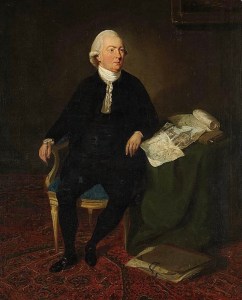
Written in 1770 “Observations on the River Wye and Several Parts of South Wales, etc Relative Chiefly to Picturesque”, to give it it’s full title, was the first travel book and one of many by William Gilpin, author, artist, travel writer, Master in Arts Oxford, clergyman and headmaster of Cheam School for Boys.
Although first published over 250 years ago in 1782, it was actually written in 1770. This publication is generally held to be the making of the Wye tour, so popular at that time, and starting the new era of tourism in Britain.
Several books have been published about the man and his book, and countless references have been made in tourist brochures, newspaper articles and on websites advertising holidays in the area of Ross on Wye to Chepstow. Not least in our society’s own recent and successful Tourism on the Wye exhibition. So many that it is rather pointless in my tying to reinvent the wheel to come up with a new one here.
Perhaps the best recent is the local production Gilpin 2020.
And Gilpin the man.
https://en.wikipedia.org/wiki/William_Gilpin_(priest)
William Gilpin. The Wye Tour. Published in 1782.
From this, an extract in section 4, about Tintern Abbey, Gilpin describes an aspect that we would now not normally contemplate, yet it is nonetheless remarkable. Imagine the reaction of middle class Georgen ladies and gentlemen enjoying the Wye tour when coming across this.
Having kept to the original spelling, except for a letter “f” for an “s”, and punctuation, I quote.
“Among other things in this scene of desolation, (Gilpin is referring to the ruinous state of the abbey buildings) the poverty and wretchedness of the inhabitants were remarkable. They occupy little huts, raised among the ruins ot the monastery; and seem to have no employment, but begging: as if a place, once devoted to indolence, could never again become the seat of industry. As we left the abbey, we found the whole hamlet at the gate, either openly soliciting alms; or covertly, under the pretence of carrying us to some part of the ruins, which each could shew; and which was far superior to any thing, which could be shewn any one self. The most lucrative occasion could not have excited more jealously, and contention.
One poor woman we followed, who engaged to shew us the monk’s library. She could not scarce crawl: shuffling along her palsied limbs, and meagre, contracted body, by the help of two sticks. She led us, through an old gate, to a space overspread with nettles and briars; and pointing to the remnant of a shuttered cloister, told us that was the place. It was her own mansion. All indeed she meant to tell us was the story of her own wretchedness; and all she had to shew us, was was her own miserable habitation. was the story of her own wretchedness. We did not expect to be interested: but we found we were. I never saw so loathsome a human dwelling. It was a cavity loftily vaulted, between two ruined walls; which streamed with various coloured stains of unwholesome dews. The floor was earth; yielding through moisture, to the tread. Not the merest utensil, nor furniture of any kind, appeared, but a wretched bedstead, spread with a few rags, and drawn into the middle of the cell to prevent its receiving the damp, which trickled down the walls. At one end was an aperture; which served just to let in enough light to discover the wretchedness, When we stood in the midst of this cell of misery; and felt the chilling damps, which struck us in every direction, we were rather surprised, that the wretched inhabitant was still alive; that she had only lost the use of her limbs.”
Later, it did occur to me that the tourists had been conned, and that the old lady did not actually live there. However, from Gilpin’s description, even if she did, her circumstances could not have been much better.
Then it occurred to me that in England today, almost 300 years later, there are still hundreds of homeless and jobless people living on our streets.
Even on the edge of some of the most prosperous areas in America, there are thousands of homeless people.
Peter Hunt.
Discover more from Whitchurch and Ganarew Area History Society
Subscribe to get the latest posts sent to your email.

 Whitchurch and Ganarew Area History Society